
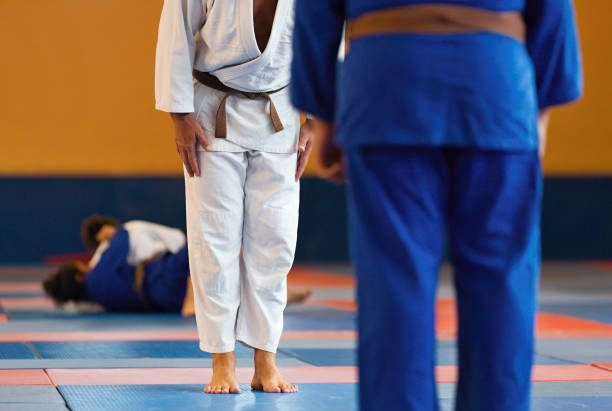
A surface that feels comfortable during warm-up can behave very differently when athletes practise repeated throws. Impact, footing and movement all matter, and a busy club may place heavy demands on the same area throughout the week. Choosing a floor therefore begins with the training taking place, not with its colour or appearance. Coaches should map typical sessions, including standing techniques, controlled breakfalls, groundwork and the experience of the people using the space.
A major consideration is how the complete floor system manages impact. The visible mat is only one part of the picture. Its thickness, density, underlying structure and installation can affect the feel of landing. A soft surface is not automatically safer, because too much give may reduce stability during entries, turns and footwork. Equally, a hard floor that provides little appropriate cushioning is unsuitable for repeated falls. Product guidance and qualified assessment should inform the choice.
For clubs comparing judo mats, the intended style and intensity of practice deserve particular attention. Beginner classes may spend more time learning breakfalls, while experienced groups may repeat standing techniques at a faster pace. Neither group should be expected to compensate for a poor landing surface through skill alone. Ask suppliers what activities their products are designed for and whether an underlay or sprung system is recommended for the intended use.
When asking for samples, request information in a form that allows fair comparison. A supplier may describe a mat as firm, resilient or impact absorbing, but these terms are not always measured in the same way. Ask for documented specifications, recommended activities, installation guidance and maintenance instructions. If two options have different underlying systems, compare the systems rather than isolated top layers. Trial pieces should not be used for unsupervised throwing tests on an unapproved floor. A coached demonstration of ordinary movement, combined with product documentation and competent advice, will usually reveal more than a quick impression from standing on the material.
Grip is another balance to examine. Athletes need enough traction to control their feet without a surface that catches them during pivots. Friction can also change with dust, sweat, cleaning products and wear. Testing a sample in normal training footwear or barefoot, as appropriate to the activity, provides more useful information than judging texture by hand. A test should include turning, kneeling, standing up and controlled movements under supervision.
Repeated use also exposes weaknesses at the edges. Interlocking systems should remain secure without creating raised lips or gaps. Larger sections need stable joins and appropriate perimeter treatment. A loose edge can become a trip point as athletes move across the room. Before each session, staff should look for separation, damaged covers, uneven areas and unexpected movement. The floor should be taken out of service when a defect makes training unsafe.
Cleaning and storage have practical costs. A permanently installed floor may support regular classes but makes inspection beneath the covering more difficult. Removable sections offer flexibility yet require safe handling, dry storage and a reliable reassembly method. Follow the manufacturer’s cleaning advice instead of assuming strong chemicals improve hygiene. Moisture trapped beneath mats can create maintenance problems even when the top appears clean.
Price comparisons are meaningful only when the full installation is considered. Delivery, preparation of the subfloor, edge treatment and replacement sections can change the overall commitment. Clubs should also establish how they will inspect and maintain the surface over time. Buying judo mats without understanding the subfloor can leave an apparently good product performing below expectations.
The final test is consistency. Athletes should be able to move between areas without encountering unexpected changes in grip, firmness or level. Staff need confidence that the surface remains stable through a full session rather than only during an initial demonstration. The most suitable judo mats support the club’s actual throwing programme, fit its maintenance routine and are installed in a way that respects the risks of repeated impacts.